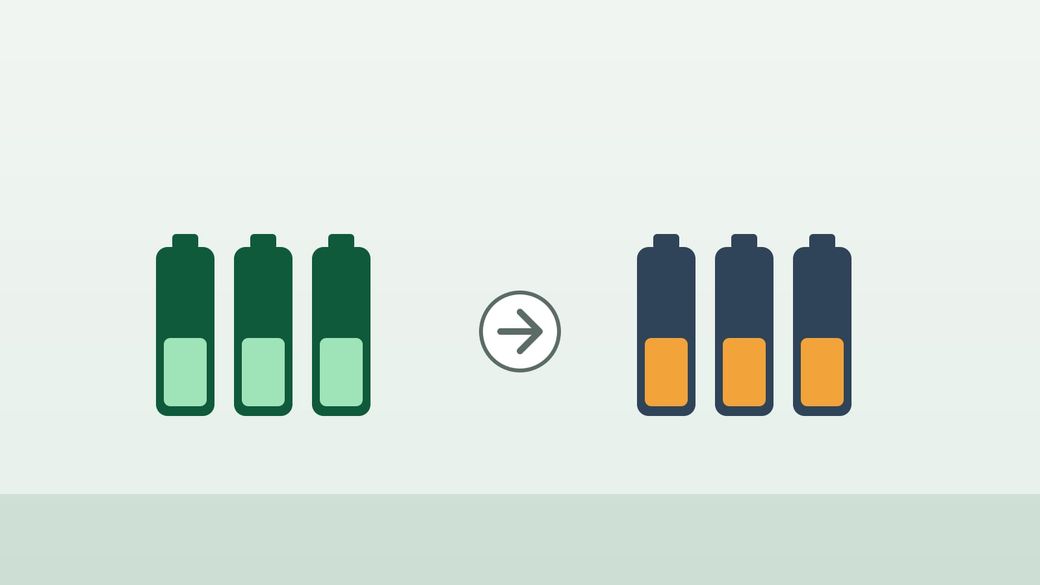
Almost every home battery sold today uses lithium-ion cells, but “lithium-ion” covers several chemistries. Two matter for home storage: LFP (lithium iron phosphate) and NMC (lithium nickel manganese cobalt oxide). They behave differently on safety, lifespan, size and cost, and the industry has largely picked a winner for stationary batteries.
Quick answer
LFP is now the standard for home and grid batteries. It stores less energy per pound than NMC, but it is more thermally stable, avoids nickel and cobalt, and is cheaper, which is why it became the primary chemistry for stationary storage starting in 2022, according to the National Laboratory of the Rockies (formerly NREL). NMC packs more energy into a smaller, lighter battery, which matters more in cars than on a garage wall.
Key takeaways
- LFP: lower energy density, higher thermal stability, no nickel or cobalt, lower cost.
- NMC: higher energy density; safety decreases as nickel content rises, according to Sandia.
- Stationary storage shifted to LFP as the main chemistry from 2022.
- Certification (UL 9540 and UL 9540A testing) and the warranty matter more than the chemistry label.
New to batteries? Start with our home battery guides.
What LFP and NMC are
Both are the positive-electrode materials in a lithium-ion cell. Sandia National Laboratories’ chapter of the Department of Energy’s Energy Storage Handbook identifies them as the two most common positive electrodes in lithium-ion batteries for grid storage:
- LFP (LiFePO₄) has a lower voltage than other common lithium-ion materials and, as a result, a lower energy density. That held it back in electric vehicles, where weight and space are at a premium. Sandia notes that its low cost and thermal stability fueled its broad adoption in grid energy storage.
- NMC (LiNiₓMnᵧCo₁₋ₓ₋ᵧO₂) mixes nickel, manganese and cobalt. Manufacturers have moved from equal shares (NMC 111) toward more nickel (532, 622, 811) for more energy. Sandia notes the trade-off: energy density increases and safety decreases as nickel content rises. It also flags supply concerns about the cobalt used in NMC.
LFP vs NMC at a glance
| LFP | NMC | |
|---|---|---|
| Energy density | Lower: bigger and heavier for the same kWh | Higher: more kWh in a smaller, lighter pack |
| Thermal stability | Higher | Lower, and decreases with more nickel |
| Critical materials | No nickel or cobalt | Uses nickel and cobalt |
| Cost | Lower | Higher |
| Where it is used today | Primary chemistry for stationary storage since 2022 | Favored where space and weight matter, such as electric vehicles |
Safety: chemistry helps, certification decides
LFP’s thermal stability is a genuine safety advantage, but no chemistry is immune to failure. What protects a home in practice is the whole system: cell design, the battery management system, thermal management and how and where the battery is installed. When you compare batteries, look for:
- UL 9540 certification of the complete energy storage system, and UL 9540A fire testing. Tesla’s Powerwall 3 datasheet, for example, lists both.
- Installation that follows your local fire code. The residential chapter of NFPA 855, the national standard for energy storage installations, covers individual units of up to 20 kWh[src]. It also limits the total energy in places like utility closets and garages and requires smoke alarms, as summarized by NFPA. Your installer and local inspector apply the version your area has adopted.
Lifespan: cycles, years and conditions
Battery life is measured in cycles (full charges and discharges), years and total energy delivered. LFP cells are generally built for long cycle life, and manufacturers’ warranties for LFP home batteries reflect that:
| Battery | Chemistry | Warranty |
|---|---|---|
| Enphase IQ Battery 5P | LFP | 15 years or 6,000 cycles (more than 60% capacity retained) |
| FranklinWH aPower 2 | LFP | 15 years or 60 MWh of energy throughput |
| Tesla Powerwall 3 | Not stated in the datasheet | 10 years |
How you use a battery matters as much as its chemistry. In a multi-year Sandia study of commercial LFP, NMC and NCA cells, operating conditions within the manufacturers’ own limits (temperature, depth of discharge and charge rate) changed how fast cells aged substantially. Keeping a battery in a moderate-temperature location and avoiding constant deep cycling helps any chemistry last longer.
Cost: why LFP took over stationary storage
LFP avoids nickel and cobalt, which keeps its materials cheaper and its supply chain less exposed. The 2024 Annual Technology Baseline from the National Laboratory of the Rockies notes that LFP became the primary chemistry for stationary storage starting in 2022, and that moving away from cobalt helps lower costs as the technology evolves. For a home battery, the lower energy density barely matters: an extra few inches or pounds on a garage wall is a small price for stability and lifespan.
For current prices, see our home battery cost guide via the related guides below, or estimate the size you need with the battery size calculator.
LFP home batteries
Pros
- More thermally stable
- No nickel or cobalt
- Lower cost per kWh
- Long-cycle warranties are common
Cons
- Larger and heavier for the same capacity
- Lower energy density
- Still needs proper certification and installation
Which should you choose?
For a home battery, LFP is the sensible default, and most new models use it. Do not dismiss a battery only because it uses NMC, and do not choose one only because it says LFP. Compare the full package: UL 9540 certification, warranty length and terms, usable capacity, power and price. Chemistry is one line on that list, not the whole decision.