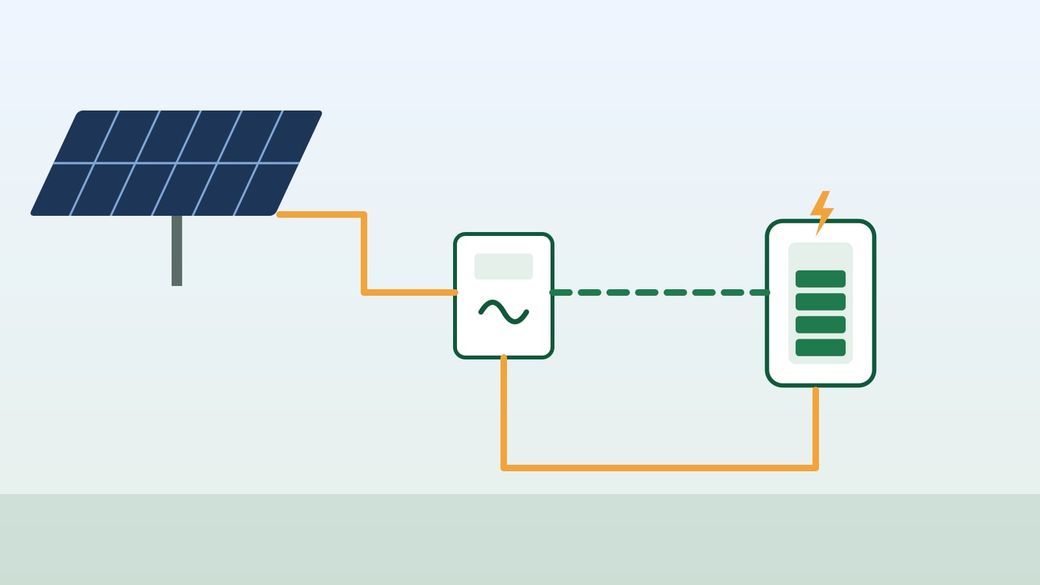
“AC-coupled” and “DC-coupled” describe where a battery connects in a solar system. The difference affects efficiency, cost and, above all, how easy it is to add a battery to panels you already have. Here is what each term means in practice and how to choose.
Quick answer
An AC-coupled battery has its own inverter and connects to your home’s AC wiring, so it can be added next to almost any existing solar system. A DC-coupled battery shares one hybrid inverter with the panels, which saves a conversion step and suits new installations. For existing solar, AC-coupled is usually simpler. For new solar plus storage, DC-coupled or all-in-one systems can be slightly more efficient. Don’t compare their efficiency ratings directly: they are measured differently.
Key takeaways
- AC-coupled: separate inverters for solar and battery; easy to add later.
- DC-coupled: one shared inverter; fewer conversions when solar charges the battery.
- The AC-coupled industry benchmark is about 90% round-trip efficiency, measured at the AC terminals.
- DC-coupled ratings often leave out inverter losses, so check what each number includes.
- Some batteries, such as Tesla Powerwall 3, work both ways.
New to batteries? Start with our home battery guides.
What AC-coupled means
In an AC-coupled system, the solar panels and the battery each have their own inverter, and they meet on your home’s AC wiring. Enphase’s technical paper describes these batteries as taking AC as input and providing AC as output, with each resource getting the conversion designed for it.
When solar charges an AC-coupled battery, the energy is converted three times: DC to AC in the solar inverter, AC to DC to charge the battery, and DC to AC again when you use it. That is the price of flexibility: the battery can be added to almost any existing system without touching the solar inverter.
What DC-coupled means
In a DC-coupled system, the panels and battery connect on a shared DC bus and use one inverter (often called a hybrid inverter). Solar energy can go into the battery as DC without first being converted to AC, which removes conversion steps. Enphase points out the trade-off: the shared inverter is a single bottleneck for both resources, so it has to be sized carefully.
The efficiency question: why ratings don’t line up
Round-trip efficiency is the share of energy you get back out of a battery. The problem is that AC-coupled and DC-coupled batteries are not measured the same way:
- For AC-coupled batteries, the rating includes the conversions in and out, measured at the battery’s AC terminals. Enphase says about 90%[src] is the industry benchmark, tested at 50% of rated power and 25 °C.
- For DC-coupled batteries, the rating often covers the battery cells and DC conversion but not the inverter, so the number can look higher than what reaches your outlets.
The fairest comparison is the full path you care about. Tesla, for example, rates Powerwall 3 (which has an integrated solar inverter) at 89% from solar to battery to home, and 98%[src] when solar goes straight to your home.
| Battery | Coupling | Stated efficiency | Measured across |
|---|---|---|---|
| Tesla Powerwall 3 | AC or DC | 89% | solar to battery to home |
| FranklinWH aPower 2 | AC-coupled | 90% | grid to battery to load |
| Enphase IQ Battery 5P | AC-coupled | 90% | AC to battery to AC |
The stated figures for these three batteries are within about one percentage point of each other. Real-world efficiency also falls when a battery runs at low power for long periods or sits idle, which Enphase notes for its own product. It matters, but it is rarely the deciding factor.
Which one should you choose?
| AC-coupled | DC-coupled / hybrid | |
|---|---|---|
| Best for | Adding a battery to existing solar | New solar + battery installations |
| Existing solar inverter | Kept | Usually replaced |
| Conversions when solar charges the battery | More (DC→AC→DC→AC) | Fewer |
| Design flexibility | Battery sized independently | Inverter shared by solar and battery |
| Examples | FranklinWH aPower 2, Enphase IQ Battery 5P | Batteries paired with a hybrid inverter; Powerwall 3 with new panels |
AC-coupled batteries
Pros
- Easy to add to existing solar
- No need to replace a working inverter
- Battery and solar can come from different brands
Cons
- More conversion steps when charging from solar
- Limits on how much existing solar each battery can back up
- More separate equipment on the wall
DC-coupled batteries
Pros
- Fewer conversions when solar charges the battery
- One inverter for solar and storage
- Clean design for new installations
Cons
- Usually means replacing the existing inverter in a retrofit
- Shared inverter can limit solar and battery output together
- Fewer brand mix-and-match options
Rule of thumb: if you already have solar that works, an AC-coupled battery is almost always the easier, cheaper path. Read how that works in practice in our guide to adding a battery to existing solar. If you are installing solar and a battery together, compare DC-coupled or all-in-one options, and judge them on the full solar-to-home efficiency and the warranty rather than the headline battery number.
To size the battery itself, use the battery size calculator.