Adding a battery to solar panels you already own is one of the most common upgrades homeowners ask about, usually after the first long outage or a switch to time-of-use rates. The short version: it is almost always possible. The details that decide cost and complexity are your inverter, the size of your solar array and your utility’s rules.
Quick answer
Yes. Most existing solar systems can take a battery without replacing the panels or the inverter, by adding an AC-coupled battery that has its own inverter. Major batteries such as Tesla Powerwall 3 and FranklinWH aPower 2 are designed for this. Check three things first: whether the battery supports your solar array’s size, what electrical work your panel needs, and how your utility treats added storage.
Key takeaways
- An AC-coupled battery connects on the AC side, so your existing solar inverter keeps working.
- Batteries limit how much existing solar they can back up: for Powerwall 3 it is 7.68 kW AC per unit, or 10 kW with Expansion units.
- Adding storage needs a new utility interconnection approval and usually a permit.
- The federal tax credit no longer applies to homeowner batteries placed in service after 2025.
For background on sizing and costs, see our home battery guides.
How a battery connects to solar you already have
There are two ways to add storage to an existing system:
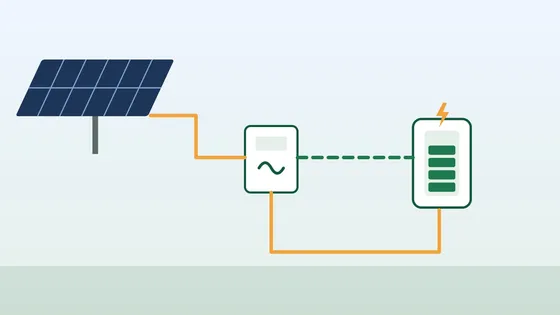
- AC-coupled (the usual retrofit). The battery has its own inverter and connects to your home’s AC wiring, alongside the solar inverter you already have. Solar power is converted to AC by your existing inverter, and the battery converts it back to DC to store it. Enphase describes these as batteries that “take AC as input and provide AC as output.”
- DC-coupled or hybrid (replacing the inverter). The panels and battery share one inverter. That avoids one conversion step, but in a retrofit it means replacing a working inverter, so it mostly makes sense when your old inverter is near the end of its life.
For a deeper look at the trade-offs, including efficiency, see our comparison of AC-coupled and DC-coupled batteries.
Which batteries work with existing solar?
| Battery | How it connects | Notes for retrofits |
|---|---|---|
| Tesla Powerwall 3 | AC-coupled to existing solar, or DC-coupled to new panels | Tesla says it is compatible with all major solar inverter brands; cannot be combined with Powerwall 2 |
| FranklinWH aPower 2 | AC-coupled | Designed as an add-on battery with its own inverter, managed by the aGate |
| Enphase IQ Battery 5P | AC-coupled (built-in microinverters) | Built for Enphase systems; ask your installer about non-Enphase inverters |
Check the solar-to-battery size limit
An AC-coupled battery has to be able to manage the solar power on its backed-up circuits during an outage, so manufacturers cap how much existing solar each battery can support. Tesla allows up to 7.68 kW[src] of third-party AC-coupled solar per Powerwall 3 in the backup circuit, or 10 kW[src] when Expansion units are installed. A larger array may need a second battery or a design that leaves part of the solar outside the backed-up circuits. Ask your installer to show you this check in the proposal.
What happens to your net metering?
Adding a battery means changing your system, so your utility will need a new interconnection application, and many cities require a permit. The big question is whether the change moves you to a newer, less generous export tariff.
In California, Tesla’s support page notes that under current policy, customers already approved under NEM 1.0 or NEM 2.0 can add battery storage later without affecting that status, while changing a design that is still pending approval can void it. Tesla also warns that policies may change. Rules differ by utility and state, so get your utility’s answer in writing before you sign.
Steps to add a battery to your solar system
- Find your inverter details. Brand, model and AC rating are on the inverter label or in your monitoring app.
- Decide what you want to back up. Essentials or the whole home? It sets the battery size. Our battery size calculator gives a first estimate.
- Get quotes from installers who service your inverter brand. Ask each one to confirm compatibility, the solar-to-battery size limit and any panel upgrade.
- Check interconnection and permits. The installer usually files these, but confirm what happens to your tariff.
- Plan for backup equipment. For outage protection you need a gateway or transfer switch that isolates your home from the grid.
How much does a retrofit cost?
The battery is priced the same whether you add it now or with new solar, but retrofits can need extra electrical work. Battery quotes averaged $1,130/kWh[src] of storage in the first half of 2026. The federal homeowner tax credit no longer applies to batteries placed in service after 2025 (0%[src]), so look for state and utility programs instead.
AC-coupled retrofit
Pros
- Keeps your existing panels and inverter
- Works with most major inverter brands
- Can be sized independently of the solar array
Cons
- One more conversion step than a DC-coupled system
- Limits on how much existing solar each battery can back up
- May need panel upgrades and a new utility approval
Bottom line
You do not need new solar to get a battery. For most homes the simplest path is an AC-coupled battery next to the existing inverter. Size it for what you want to back up, check the solar-to-battery limit and confirm with your utility how storage affects your export credits before you commit.