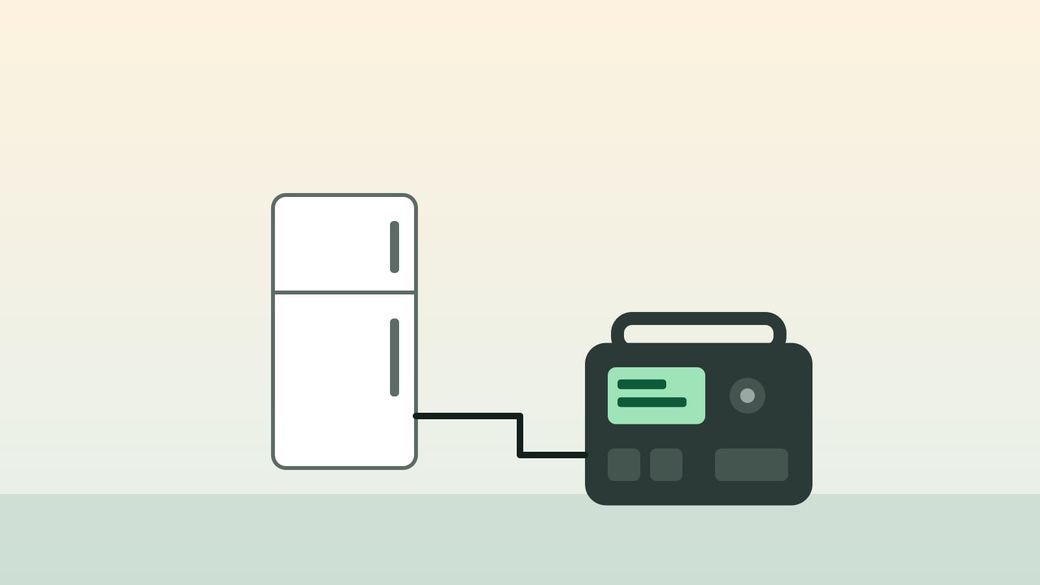
Keeping the refrigerator cold is the first priority in most outages, and it is the job portable power stations (often sold as “solar generators”) do best. The size you need depends on how much energy your fridge uses each day and how long you want to keep it running.
Quick answer
The average main refrigerator in U.S. homes uses about 617 kWh/year[src], or roughly 1.69 kWh a day, according to the EIA. With a 15% margin for losses, that means about 1,940 Wh of battery per day: a 2,000 Wh station covers about a day, and a 4,000 Wh station covers about two. To recharge it from the sun you need roughly 440 W of solar panels in good conditions.
Key takeaways
- Plan on about 1,940 Wh per day for a typical fridge, more for older or larger models.
- A fridge plus a separate freezer roughly doubles the energy you need.
- Check that the power station can handle the compressor start-up surge.
- Solar panels can refill the station on sunny days, but plan for cloudy ones.
Browse more options in our backup power guides.
How much energy does a refrigerator use?
The EIA’s Residential Energy Consumption Survey reports how much electricity fridges and freezers use in the average U.S. home that has them:
| Appliance | Per year | Per day |
|---|---|---|
| Main refrigerator | 617 kWh/year | 1.69 kWh |
| Second refrigerator | 494 kWh/year | 1.35 kWh |
| Separate freezer | 570 kWh/year | 1.56 kWh |
Your own fridge may differ. The yellow EnergyGuide label on newer models shows estimated kWh per year; divide by 365 for a daily figure. Older fridges, side-by-side models and units in hot garages usually use more. During an outage you can help by keeping the door closed and the fridge full.
How big a power station do you need?
Multiply your daily kWh by the number of days, then add a margin. We use 15% to cover the power station’s inverter losses and the fact that batteries do not deliver every last watt-hour. That margin is our planning assumption, not a manufacturer figure.
| What you want to run | Energy used | Capacity to plan for | Stations in our data that cover it |
|---|---|---|---|
| Main fridge, 1 day | 1.7 kWh | 1,940 Wh | EcoFlow DELTA Pro 3, Jackery HomePower 3000, Anker SOLIX F3800 Plus |
| Main fridge, 2 days | 3.4 kWh | 3,890 Wh | EcoFlow DELTA Pro 3 |
| Main fridge, 3 days | 5.1 kWh | 5,830 Wh | Needs an expansion battery or a larger unit |
| Fridge + separate freezer, 1 day | 3.3 kWh | 3,740 Wh | EcoFlow DELTA Pro 3, Anker SOLIX F3800 Plus |
| Fridge + separate freezer, 2 days | 6.5 kWh | 7,480 Wh | Needs an expansion battery or a larger unit |
Don’t forget power and surge
Capacity (Wh) decides how long the fridge runs. Power (W) decides whether the station can start it. A fridge compressor draws extra power for a moment each time it starts, so check:
- the fridge’s rated amps or watts on its label, and
- the power station’s continuous and surge (peak) ratings.
Large stations handle a household fridge easily. For example, the Jackery HomePower 3000 is rated for 3,600 W[src] continuous and 7,200 W[src] surge. Small stations can struggle with older or larger fridges, so compare ratings before you buy.
How many solar panels to keep it running?
To replace a day’s refrigerator use from the sun, divide the daily energy by the peak sun hours and the system efficiency. Using the median of 5.1 hours[src] of sun across the largest U.S. metro areas and 76%[src] efficiency (both from NLR’s PVWatts model, for a tilted, south-facing array), a typical fridge needs about 440 W of panels, and a fridge plus freezer about 840 W.
Portable panels propped on the ground are rarely at the ideal angle, and storms often bring clouds, so plan for less. Treat solar as a way to stretch your stored energy rather than a guarantee.
Running a fridge on a solar generator
Pros
- Silent and safe indoors, unlike a gas generator
- A 2,000 Wh station covers about a day; 4,000 Wh about two
- Solar panels can extend runtime on sunny days
Cons
- Long outages need recharging or more capacity
- Old or large fridges use more energy
- Cloudy weather limits solar recharging
Bottom line
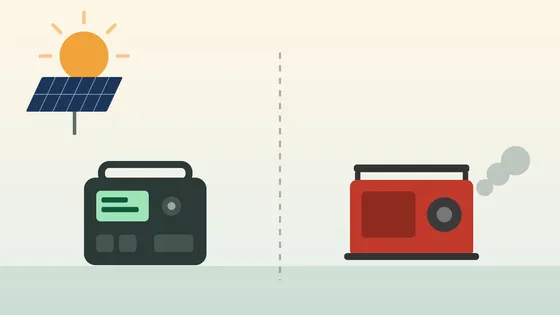
For one fridge, aim for at least 2,000 Wh for a day of backup or about 4,000 Wh for two days, plus around 440 W of solar if you want to recharge from the sun. Add a freezer and you need roughly twice that. If you are also deciding between a power station and a gas generator, compare the two on energy, safety and noise.
To size a bigger backup system for more of your home, use the battery size calculator.