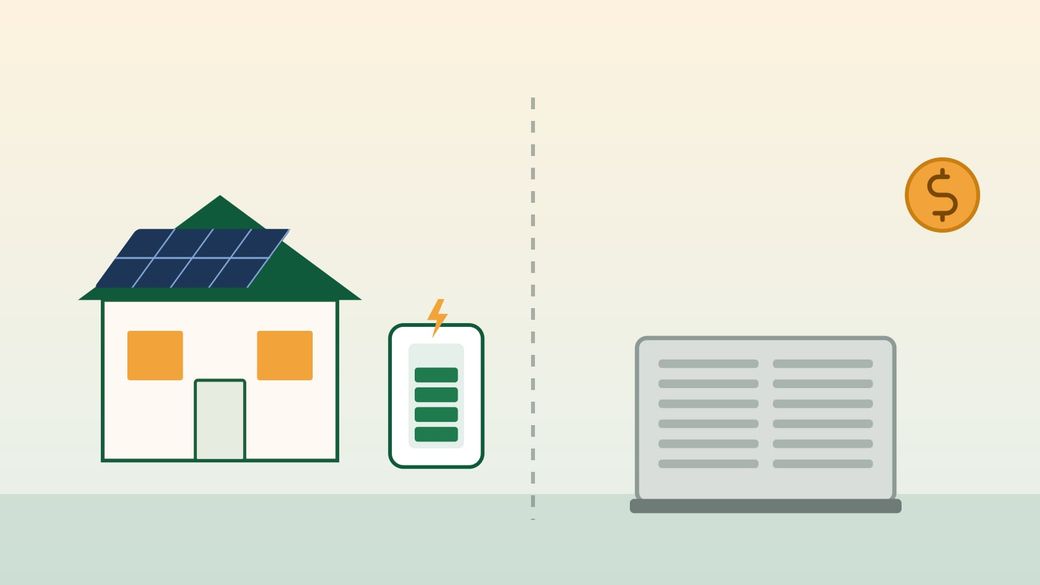
If you want your home to keep running automatically when the grid fails, you have two main choices: a permanently installed standby generator, or a home battery (often paired with solar). Both switch on automatically when the grid fails, but they differ sharply in price, how long they can run and what they do the rest of the year.
Quick answer
For whole-home backup during long outages, a natural gas standby generator is usually cheaper: Generac puts most installed systems at $8,000[src] to $16,000, and fuel adds only tens to a few hundred dollars over 10 years at typical outage hours. A home battery costs about $15,647[src] per 13.5 kWh unit and stores a limited amount of energy, but it is silent, needs no fuel and can save money every day on time-of-use rates or with solar.
Key takeaways
- Standby generator: $8,000–$16,000 installed (Generac), runs as long as the gas supply holds.
- Fuel: about $340 per 100 hours of outage at half load on natural gas (our calculation).
- Battery: about $13,055–$15,647 per 13.5 kWh unit; whole-home backup often needs two or more.
- Warranty: 5 years on Generac's standby generator vs 10 years on Powerwall 3.
- Batteries can earn money year-round; generators only help during outages.
Find more options in our backup power guides.
Upfront cost
Standby generator. Generac says installed costs for a home standby generator range from $8,000 to $16,000, including the generator, equipment, materials and installation. Price depends on the generator size, your fuel type, the transfer switch, permits and your location.
Home battery. Installer quotes on EnergySage averaged $15,647[src] for a typical 13.5 kWh system in the first half of 2026, and about $13,055[src] for a Tesla Powerwall. One unit covers essentials or part of a home; whole-home backup with air conditioning usually needs two or more, so the price rises accordingly. There is no federal tax credit for homeowner batteries placed in service after 2025.
Running cost: fuel and outages
A standby generator only burns fuel when it runs. Generac lists 221 ft³/hour[src] of natural gas at 50% load for its 22 kW model. At the 2025 U.S. average residential gas price of $15.34 per 1,000 ft³[src], that is about $3.39 per hour of outage (our calculation).
How many hours will it run? According to the EIA, U.S. customers averaged 11 hours[src] of power interruptions in 2024, a bad hurricane year, while South Carolina customers averaged nearly 53 hours[src]. Even at the higher figure, fuel for outages is modest. Generators also run briefly on a schedule to exercise themselves, and they need periodic maintenance; ask your dealer what a service plan costs, because that is a real ongoing expense.
A battery’s running cost is the electricity used to recharge it, which is small, and it needs very little maintenance.
10-year cost comparison
| Option | Upfront | Fuel over 10 years | Total (excluding maintenance) |
|---|---|---|---|
| Standby generator, low end, U.S.-average outages | $8,000 | $370 | $8,370 |
| Standby generator, high end, South Carolina-level outages | $16,000 | $1,800 | $17,800 |
| One 13.5 kWh battery (typical quote) | $15,650 | $0 | $15,650 |
| Two 13.5 kWh batteries (2 × typical quote) | $31,290 | $0 | $31,290 |
On cost alone for backup, the generator usually wins. The picture changes if the battery also lowers your bills: on time-of-use rates, or with solar under a tariff that pays little for exports, a battery can return some of its cost every year, which a generator never does.
What each can and can’t do
| Standby generator | Home battery | |
|---|---|---|
| How long it can run | As long as fuel lasts (natural gas: grid supply; propane: tank size) | Limited by stored energy unless solar recharges it |
| Power for big loads | Can cover a whole home if sized for its loads | About 11.5 kW per Powerwall 3; add units for more |
| Noise and emissions | Engine noise and exhaust outdoors | Silent, no emissions on site |
| Everyday value | None outside outages | Can cut bills with solar and time-of-use rates |
| Maintenance | Regular service, oil, exercise cycles | Minimal |
| Warranty | 5 years | 10 years |
Standby generator
Pros
- Runs for days on natural gas
- Can cover the whole home if sized for it
- Lower upfront cost for whole-home backup
Cons
- Noise and exhaust
- Ongoing maintenance
- No value outside outages
- Depends on fuel supply
Home battery
Pros
- Silent and emission-free
- Works with solar for multi-day backup on sunny days
- Can save money every day
Cons
- Limited energy without solar
- Whole-home backup needs several units
- Higher upfront cost per hour of backup
Which should you choose?
A standby generator makes sense if your outages are long (multi-day storms, ice), you need to run central air or electric heat, and you have natural gas or room for a propane tank.
A home battery makes sense if your outages are usually short, you have or plan solar, your utility uses time-of-use rates or pays little for exported solar, or noise and emissions matter.
Some homes combine both: a battery for instant, quiet backup and everyday savings, and a generator for the rare long outage. To size a battery for your home, use the battery size calculator, and see how long a Powerwall runs a house in an outage.