It surprises many new solar owners: the first time the power goes out on a sunny afternoon, the house goes dark too. That is not a fault. It is how most grid-connected solar systems are designed, and there are good reasons for it. Here is why it happens and what it takes to keep using your panels in a blackout.
Quick answer
Usually not. Standard grid-tied solar shuts off automatically when the grid goes down, so it cannot feed power into lines that utility crews may be repairing. To use your panels during an outage, you need either a home battery with backup equipment, which also works at night, or a special inverter that offers daytime-only backup, such as Enphase Sunlight Backup or SMA’s Secure Power Supply outlet.
Key takeaways
- Grid-tied inverters stop producing within moments of a grid outage. This is a safety requirement, not a malfunction.
- A battery plus backup equipment lets solar power your home and recharge the battery during an outage.
- Some inverters can power a few circuits or one outlet with no battery, but only while the sun is shining.
- Never connect a generator or battery to your home wiring without a transfer switch or gateway.
Find more ways to keep the lights on in our backup power guides.
Why rooftop solar shuts off when the grid goes down
A grid-tied solar system uses an inverter to turn the panels’ DC power into AC power that matches the grid. When that inverter senses that grid power is gone, it stops producing. The U.S. Department of Energy’s Federal Energy Management Program explains it simply: for safety, a solar array shuts down when it senses a loss of grid power.
The reason is the people fixing the outage. If thousands of homes kept pushing solar power into the neighborhood lines, a line that should be dead could be live. Inverters are therefore built to recognize an outage and stop exporting power within moments, which is often called anti-islanding protection.
The catch is that a standard system has no way to disconnect your house from the grid and keep running on its own. So when the inverter shuts off to protect the grid, it shuts off for your home too, even on a bright, sunny day. Tesla puts it plainly on its support pages: a traditional solar system without a Powerwall does not work during a grid outage.
Four ways to use solar power during an outage
| Option | Works at night? | What it can power | Main limitation |
|---|---|---|---|
| Home battery + backup gateway | Yes | Selected circuits or the whole home, depending on size | Cost; capacity runs out without sun |
| Daytime solar backup (e.g. Enphase Sunlight Backup) | No | A few essential circuits | Stops when clouds or evening cut production |
| Inverter outlet (e.g. SMA Secure Power Supply) | No | One outlet, up to about 2,000 W | Output follows the sunlight |
| Portable power station + portable panels | Yes, from stored energy | Devices plugged into the station | Small capacity; separate from your roof system |
1. A home battery with backup equipment
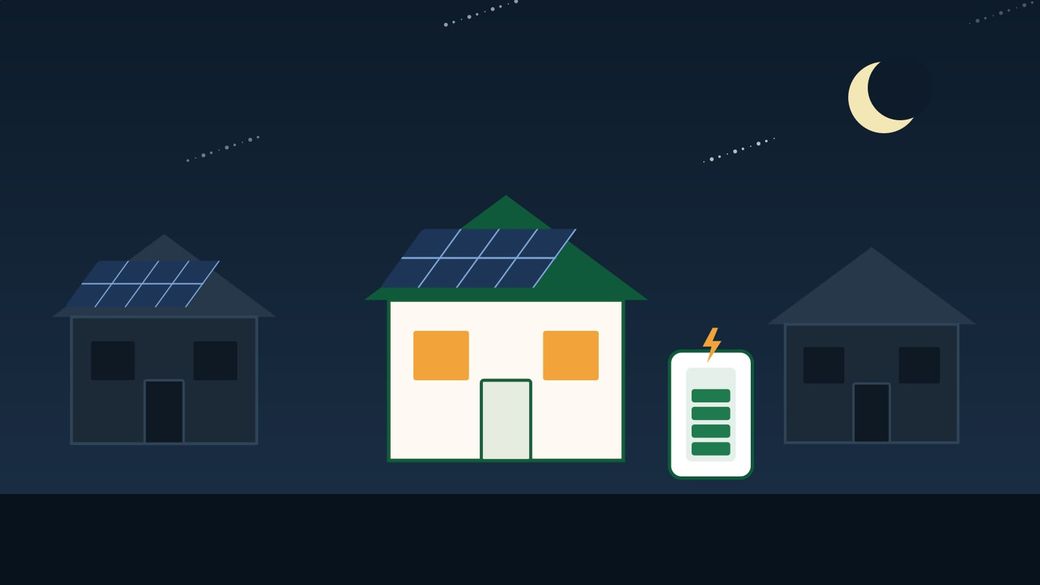
This is the only option that keeps power flowing after sunset. The battery system includes a gateway or backup switch that disconnects your home from the grid when it detects an outage, so your panels and battery can safely run the house on their own. Tesla says the switch happens in a fraction of a second and that, with solar, Powerwall can recharge from the panels while the grid is down. If the battery runs low, it goes into standby and automatically tries to recharge from solar every hour between 8 AM and 4 PM.
How long you can last depends on the battery size and what you run. See how long a Powerwall runs a house, and size your own system with the battery size calculator. Batteries are the most capable option and also the most expensive: 2026 quotes averaged $1,130/kWh[src] of storage.
2. Daytime solar backup without a battery
Enphase’s Sunlight Backup uses IQ8 microinverters, which can form their own small grid, together with an IQ System Controller 2 and at least one IQ Load Controller. During a daytime outage it powers up to four 240 V or eight 120 V essential circuits, such as the refrigerator, Wi-Fi and a few lights.
Enphase is clear about the limits: it is for essential loads only, not the whole home, and the system can shut down when clouds, shade or evening reduce production below what the loads need. It recommends keeping backed-up loads to no more than 30%[src] of the microinverters’ rated output. In Enphase’s own example, a system with 24 IQ8 microinverters is rated 5.7 kW[src], so backup loads should stay under 1.7 kW.
3. An inverter with a daytime outlet
Some SMA Sunny Boy inverters sold in the U.S. include a Secure Power Supply feature: a dedicated outlet that provides power during an outage while the panels are producing. SMA says it delivers up to 2,000 W[src] of “opportunity power”, enough for something like a refrigerator. Because there is no battery, the outlet only works in daylight and its output rises and falls with the sun. Check your inverter’s model and manual to see whether it has this feature and how it is wired.
4. A portable power station with folding panels
A portable power station is a battery with built-in outlets. Paired with portable solar panels, it can recharge during the day and run phones, lights, a router or, with a large enough unit, a refrigerator. It is completely separate from your rooftop system, so it does not use your roof panels, but it is the cheapest way to get some solar-powered backup.
Battery backup vs daytime-only solar backup
Pros
- Battery: works day and night
- Battery: can cover the whole home if sized for it
- Daytime-only: no battery to buy
- Daytime-only: keeps essentials running on sunny days
Cons
- Battery: highest cost
- Battery: lasts only as long as its stored energy without sun
- Daytime-only: nothing at night
- Daytime-only: limited circuits and power; clouds can shut it down
Can I add outage backup to the solar I already have?
Often, yes. Many batteries can be added to an existing system, usually as an AC-coupled battery that works alongside your current inverter. Whether you can use daytime-only backup depends on the inverter you already own: Sunlight Backup requires IQ8 microinverters, and the SMA outlet exists only on models with that feature. Ask an installer to check your inverter model before you buy anything.
Bottom line
Standard solar panels will not keep your lights on in a blackout, by design. If backup power matters to you, the reliable answer is a battery with backup equipment. If your budget is tight and your inverter supports it, daytime-only backup can keep essentials running on sunny days, and a portable power station can cover the basics at night.